
Stem Cell Therapy for Knees in Orange County: A Complete Patient Guide
For patients in Orange County living with chronic knee pain, osteoarthritis, or cartilage damage, stem cell therapy for knees offers a clinically grounded alternative to cortisone injections or surgery. OC Wellness Physicians Medical Group provides physician-directed regenerative knee care across four locations in Westminster, Irvine, Orange, and Mission Viejo. This guide explains how the therapy works, which conditions it addresses, what the procedure involves, and what a realistic recovery looks like so that patients can make informed decisions with their clinical team.
What Is Stem Cell Therapy for Knees and How Does It Work?
Stem cell therapy for knees is a form of regenerative medicine that uses perinatal tissue allografts — biologic products derived from amniotic tissue and umbilical cord blood — to support the body’s natural tissue repair response inside a damaged knee joint. These tissues are donated by healthy mothers following scheduled, full-term cesarean births. Donation follows strict informed-consent protocols, and the tissue is processed at FDA-registered facilities under Section 361 of the Public Health Service Act, which governs human cells, tissues, and cellular and tissue-based products.
Once introduced into the joint, these biologics deliver a concentrated mix of cytokines, growth factors, hyaluronic acid, collagen scaffolding components, and mesenchymal cellular elements. Rather than acting only as anti-inflammatory agents, they signal surrounding tissue to engage its own repair cascade, supporting the structural environment of the joint over time. This mechanism is what distinguishes regenerative therapy from cortisone, which reduces inflammation temporarily but does not address the underlying structural deficiency producing the pain.
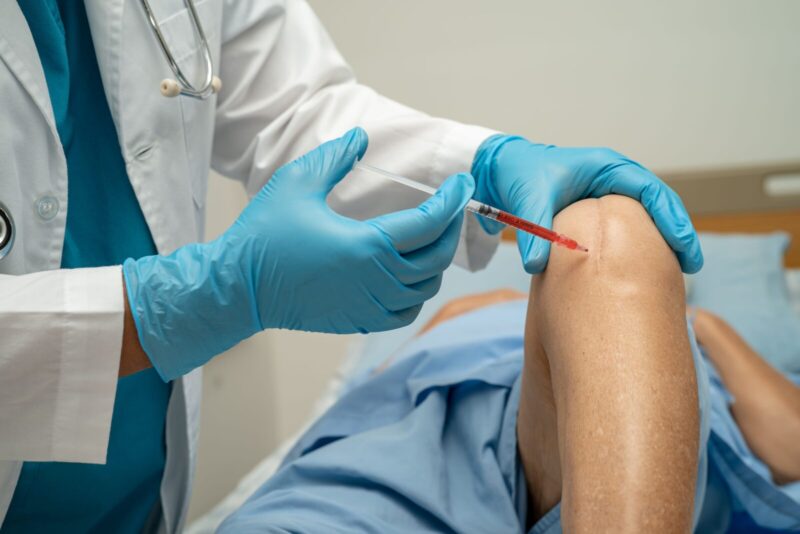
The procedure itself is minimally invasive. Injections are placed into the intra-articular space of the knee using a standardized anatomical-landmark technique that allows the clinical team to deliver the biologic accurately into the joint. Accurate placement matters because even a well-prepared biologic loses therapeutic potential if it does not reach the target tissue. Refined injection technique is a clinical standard at OC Wellness Physicians Medical Group and forms the foundation of safe regenerative care.
Scientific interest in perinatal-tissue regenerative therapy has grown considerably over the past decade. Peer-reviewed publications have reported favorable outcome data for pain reduction and functional improvement in appropriate candidates. While research is ongoing, the existing clinical literature supports the rationale for using amniotic and umbilical-cord-derived biologics as part of a comprehensive knee care strategy for suitable patients.
Which Knee Conditions Are Best Suited for Stem Cell Treatment?
Patient selection is one of the most important factors in achieving favorable outcomes with stem cell therapy for knees. The clinical team at OC Wellness Physicians Medical Group performs a thorough evaluation before recommending any regenerative protocol, because the therapy is not appropriate for every presentation of knee pain. Understanding which conditions tend to respond well helps patients approach that conversation with informed expectations.
Mild-to-moderate osteoarthritis, typically categorized as Kellgren-Lawrence grades 1 through 3, represents one of the most commonly treated indications. In these patients, cartilage loss is present but has not yet progressed to the complete joint-space collapse seen in end-stage arthritis. The surviving tissue provides enough of a biological environment for regenerative signaling to work effectively. Patients at grade 4, where bone-on-bone contact is extensive, tend to see more limited benefit and may be better served by discussing surgical options.
Meniscus tears, particularly partial or degenerative tears in patients who are not strong surgical candidates due to age, comorbidities, or personal preference, represent another well-supported indication. Surgical meniscectomy carries its own long-term risks, including accelerated cartilage loss, and some patients benefit from a regenerative approach that supports healing of the remaining tissue without further reducing meniscal volume.
Chondromalacia patella and focal cartilage defects are conditions that frequently affect younger, active patients who want to preserve knee function and delay or avoid joint replacement. Similarly, ligament sprains or partial tears that have not fully resolved with physical therapy and conservative care may be appropriate for regenerative injection when surgical reconstruction would otherwise be the next consideration. The right approach depends on the specific anatomy involved, the degree of structural compromise, and the patient’s functional goals.
A physician-directed evaluation at OC Wellness Physicians Medical Group includes a thorough review of imaging studies such as MRI or X-ray alongside a functional assessment of the knee. This process allows the clinical team to confirm whether regenerative therapy is an appropriate path forward and to identify any contributing factors, such as gait abnormalities or muscle imbalances, that should be addressed alongside the injection protocol. Patients can also learn about complementary options through our pain management services.
What Happens During a Stem Cell Knee Injection Procedure?
The process begins before any injection takes place. At OC Wellness Physicians Medical Group, the initial consultation includes a detailed review of the patient’s MRI or X-ray imaging to stage the degree of joint damage and confirm clinical candidacy. This step is not a formality. The imaging findings directly inform which biologic option is most appropriate for the specific knee condition and whether a single injection or a planned series is more likely to support meaningful improvement.
Two perinatal tissue options are commonly used. Amniotic tissue products are derived from the amniotic membrane and fluid, which contain growth factors, cytokines, hyaluronic acid, and collagen substrates that support joint cushioning and biological signaling. Umbilical cord blood and Wharton’s Jelly — the connective tissue surrounding the umbilical vessels — contain mesenchymal cellular elements and a concentrated cytokine and growth factor profile that supports cellular communication during the repair phase. OC Wellness Physicians Medical Group is one of the few practices in the country offering both amniotic and umbilical-cord-derived therapy, which allows the clinical team to match the biologic to the patient’s specific knee condition rather than fitting every patient to a single protocol.
Because perinatal tissue products are allografts, there is no harvest step from the patient’s body. This is a meaningful advantage over autologous regenerative protocols that require collection from a second site on the patient, which adds procedure time, mild discomfort, and a second healing area to manage. The biologic arrives at the appointment pre-processed and ready for injection.
The injection itself is delivered into the intra-articular space of the knee using a standardized anatomical-landmark technique. Because the knee is a large, accessible joint, experienced clinicians can reliably deliver biologic injections into the joint space using palpation and surface landmarks. Accurate placement is essential — the biologic must reach the joint space to have therapeutic effect — and the clinical team’s injection protocol is built around that requirement. The entire appointment typically spans under an hour, and patients return home the same day with no incision care, no harvest site to manage, and no extended recovery from a separate collection procedure.
Patients interested in exploring how regenerative injections complement other modalities such as laser therapy are encouraged to discuss those options during the initial consultation. A coordinated approach often produces better outcomes than any single intervention in isolation.
Recovery Timeline and What Patients Can Realistically Expect
Understanding the recovery process before undergoing stem cell therapy for knees allows patients to plan appropriately and avoid misinterpreting normal post-procedure responses as signs that something has gone wrong. The days immediately following a knee injection involve a period of local inflammation that is both expected and, to a degree, therapeutically useful. Mild soreness, warmth, and joint swelling during the first 48 to 72 hours reflect the body’s biological response to the injected material and should not be a cause for concern.
During the first one to two weeks after the procedure, most patients are advised to avoid high-impact physical activity including running, jumping, and heavy resistance exercise involving the knee. Low-impact movement such as walking and gentle range-of-motion exercises is generally encouraged, as it helps maintain circulation and prevents stiffness without placing excessive mechanical stress on the recovering joint. The clinical team at OC Wellness Physicians Medical Group provides individualized activity guidelines based on the patient’s baseline fitness level, the extent of structural damage, and the biologic used.
Early functional changes, particularly reductions in pain and improved joint mobility, are sometimes noticed within four to six weeks of the initial injection. However, patients should understand that regenerative therapy works through a biological process that unfolds over time. The full response, including any structural changes in cartilage or soft tissue, continues to develop over three to six months. Assessing outcomes too early in this window can lead to premature conclusions that do not reflect the therapy’s complete effect.
Scheduled follow-up evaluations at OC Wellness Physicians Medical Group allow the clinical team to track the patient’s progress, adjust rehabilitation protocols if needed, and determine whether additional treatment cycles are likely to be beneficial. Some patients achieve their goals following a single procedure, while others benefit from a second injection at the three-to-six-month mark. This decision is made based on objective assessments rather than a fixed protocol, which is one of the advantages of receiving care within a coordinated multi-specialty practice rather than a standalone injection clinic.
It is important for patients to approach this therapy with realistic expectations. Outcomes are influenced by a range of individual factors including age, body weight, the severity of pre-existing joint degeneration, and adherence to post-procedure guidelines. Patients who engage actively with their rehabilitation and maintain healthy activity levels tend to report more durable results than those who return immediately to high-impact routines or who have significant underlying health conditions affecting tissue healing.
Why OC Wellness Physicians Is Orange County’s Regenerative Medicine Resource
OC Wellness Physicians Medical Group is structured as a multi-specialty medical group rather than a single-provider clinic. This distinction matters for patients seeking regenerative knee care because it means that imaging review, candidacy assessment, injection delivery, and follow-up rehabilitation are all coordinated within a single clinical framework. Patients do not need to manage referrals between separate facilities or piece together care from providers who are unfamiliar with one another’s recommendations.

Physician-directed protocols ensure that every step of the process, from the initial evaluation through post-procedure follow-up, is clinically supervised. This level of oversight supports both patient safety and treatment consistency. The clinical team applies standardized protocols for imaging review, biologic selection, and injection technique while also individualizing care based on each patient’s specific anatomy and clinical presentation. OC Wellness Physicians Medical Group is one of the few practices in the country to offer both amniotic stem cell treatment and umbilical cord blood therapy, which gives the clinical team meaningful flexibility in matching the biologic to the patient.
Four locations across Orange County, in Westminster, Irvine, Orange, and Mission Viejo, mean that patients throughout the region can access regenerative knee care without traveling out of the area. Proximity to care is a practical factor that affects patient adherence, particularly during the follow-up phase when repeat evaluations support optimal outcomes. Details about each site are available on the locations page.
For patients who are navigating knee injuries following an accident or personal injury event, OC Wellness Physicians Medical Group does not require upfront payment for qualifying cases and accepts a range of insurance arrangements for regenerative consultations. This approach removes financial barriers that often delay treatment in the critical early window after an injury occurs. A full explanation of billing arrangements is available through the contact and intake process.
Patients can also explore the full range of services offered at OC Wellness Physicians Medical Group, including how regenerative care integrates with the broader treatment philosophy, through the practice’s informational resources. The goal at every location is the same: to provide clinically grounded, physician-directed care that addresses the root cause of knee pain rather than simply managing its symptoms.
Is Stem Cell Therapy for Knees Covered by Insurance?
Most major insurance carriers currently classify stem cell knee injections as investigational and do not cover the procedure under standard benefits. This classification reflects the ongoing nature of clinical research rather than a judgment about clinical value, but it does have practical implications for patients who are planning their care. OC Wellness Physicians Medical Group can discuss available financing options and, for personal injury patients, lien-based billing arrangements during the initial consultation so that cost does not become a barrier to accessing appropriate care.
How Many Stem Cell Injections Will I Need for My Knee?
The number of treatment sessions required depends on several clinical variables including the severity of joint damage, the biologic selected, and the individual patient’s response to initial therapy. Many patients experience meaningful improvement in pain and function following a single procedure. Others benefit from a follow-up injection administered at three to six months if the clinical team determines that a second cycle is likely to extend or deepen the initial response. This decision is based on objective progress assessments rather than a preset protocol.
Is Stem Cell Therapy for Knees Safe?
When performed by trained physicians using a standardized anatomical-landmark technique and strict sterile protocol, stem cell knee injections carry a low overall risk profile. Perinatal tissue allografts are processed at FDA-registered facilities under strict donor-screening and sterility standards, which addresses the safety concerns that historically applied to early allograft products. Temporary soreness and localized swelling at the injection site are the most commonly reported side effects and typically resolve within a few days. As with any injection procedure, infection risk exists but is minimized through rigorous sterile technique. Patients with specific health conditions or medication regimens should discuss those factors during the initial evaluation so the clinical team can account for any individual considerations.
How Long Does a Stem Cell Knee Injection Last?
Clinical studies report pain and functional improvements lasting one to three years or longer in patients who are appropriate candidates for the therapy. The durability of results is influenced by a number of factors including the degree of pre-existing joint degeneration, the patient’s activity level and body weight, and whether the underlying condition continues to progress after treatment. Patients who address contributing lifestyle factors and adhere to their rehabilitation protocols tend to report more sustained outcomes than those who return to activities that place excessive mechanical stress on the joint.

Can Stem Cell Therapy Help Me Avoid Knee Replacement Surgery?
For patients with mild-to-moderate osteoarthritis or structural damage that has not yet reached end-stage deterioration, regenerative therapy may delay or, in some cases, eliminate the need for total knee replacement. This is one of the most significant potential benefits of the treatment for the right candidate. A physician-directed evaluation that includes current imaging is necessary to determine whether an individual patient’s joint condition is within the range where regenerative therapy is likely to be effective as an alternative to surgical intervention.
What Is the Difference Between PRP and Stem Cell Therapy for the Knee?
Platelet-rich plasma (PRP) and stem cell therapy are both regenerative options, but they work through different mechanisms. PRP is prepared from the patient’s own blood and concentrates the growth factors found in platelets. It has a well-documented anti-inflammatory effect and is particularly useful in conditions where growth factor signaling is the primary therapeutic target. Perinatal tissue allograft therapy, by contrast, introduces a broader concentration of growth factors, cytokines, hyaluronic acid, and mesenchymal cellular elements derived from amniotic or umbilical tissue. The appropriate choice between the two depends on the type and extent of knee damage, and in some cases the two modalities may be combined as part of a single treatment protocol.
Where Can I Get Stem Cell Therapy for Knees in Orange County?
OC Wellness Physicians Medical Group offers physician-directed stem cell knee therapy at four locations throughout Orange County, serving patients in Westminster, Irvine, Orange, and Mission Viejo. The clinical team at each location is equipped to conduct comprehensive evaluations, review imaging, prepare and administer biologic injections, and coordinate follow-up care within the practice’s integrated multi-specialty model. Patients who have questions about whether they are candidates for regenerative knee care are encouraged to schedule an initial consultation to discuss their specific history and imaging findings with the clinical team.
To schedule an evaluation with the clinical team at OC Wellness Physicians Medical Group, call (714) 735-0313 today. Our staff can arrange same-day or next-day appointments at the location most convenient for you. For patients managing knee injuries related to an accident or personal injury matter, please visit our patient injury care page to understand your billing options, or explore our attorney support services if you are coordinating care with legal representation.